About the Project
***A note to scholars, students, and researchers in general: please be sure to properly credit any usage of text or images on this website in your writings. Also, we'd love to read what you're writing about the Bray Studios--feel free to contact us or post on our discussion board!***
For the record...
Paper
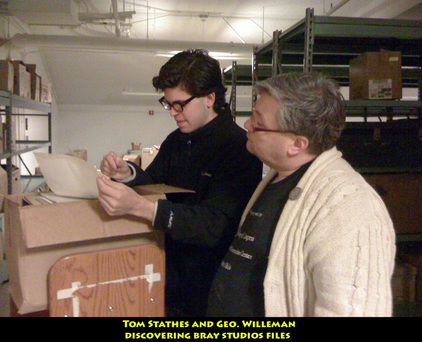
Numbering in the low thousands of pages, the collection is comprised of copies of all relevant papers from the remains of the studio as well as items that were sold on the open market or copied from other private collectors.
Films
The Bray Studios produced roughly 540 animated films between 1913 and 1936. The majority were of the comical "cartoon" type, but numerous educational and technical animated films were also included.-The collection currently comprises approximately 150 of the films in 16mm format, 30 in 28mm and some 15 on video formats, totaling about 195 subjects. An additional 60 or so subjects are referenced as being in other private or archival collections, making the total number of estimated extant Bray Studios animated films to be 255 of 540, or just over 47%, which is a very promising figure for silent-era films. It's very likely that many more subjects are out there waiting to be found.The project seeks to build mutually beneficial relationships with other private collectors and archives for the greater good of uniting this historic body of artistic works. If you have anything of interest, let us correspond with you.
Numbering in the low thousands of pages, the collection is comprised of copies of all relevant papers from the remains of the studio as well as items that were sold on the open market or copied from other private collectors.
Films
The Bray Studios produced roughly 540 animated films between 1913 and 1936. The majority were of the comical "cartoon" type, but numerous educational and technical animated films were also included.-The collection currently comprises approximately 150 of the films in 16mm format, 30 in 28mm and some 15 on video formats, totaling about 195 subjects. An additional 60 or so subjects are referenced as being in other private or archival collections, making the total number of estimated extant Bray Studios animated films to be 255 of 540, or just over 47%, which is a very promising figure for silent-era films. It's very likely that many more subjects are out there waiting to be found.The project seeks to build mutually beneficial relationships with other private collectors and archives for the greater good of uniting this historic body of artistic works. If you have anything of interest, let us correspond with you.
An important note.
The Bray Animation Project is a private venture without any sort of commercial underwriting or academic affiliation and is funded by personal time, petty cash, and the generosity of fellow historians and archivists. The project is a labor of love that is able to move forward not only through the individual fervor of its organizer but also by the realization and acceptance that there shall be no accreditation, official nature, or 'qualification' concerning the individual(s) acting to gather information and materials for this project. Furthermore, 'qualification' to seek archival or private materials that would be of benefit to this project should be considered the great interest and efforts invested in as well as hundreds of acquisitions made for the project to date.
This project would not be possible without direct support from the following individuals.
Stefan Aaron, Jerry Beck, Howard Beckerman, Robert Birchard, Rusty Casselton, Craig Davison, Dino Everett, Jorge Finkielman, Bob Furmanek, the crucially indispensable David Gerstein, Murray Glass, Larry Groebe, Cole Johnson, Charlie Judkins, Thad Komorowski, Andy Madura, Virginia Mahoney, Mike Matei, Valentin Moretto, Mark Newgarden, Dominique Noujeim, Ray Pointer, Tim Romano, Jerry Rotondi, Scott Schutte, Ronald Schwarz, J.J. Sedelmaier, Pietro Shakarian, Ronald Simons, Steve Stanchfield, Dave Stevenson, Brian Taves, Ned Thanhouser, Jack Theakston, and last but CERTAINLY not least, George Willeman.
Precursors to Research by Thomas J. Stathes
My cause in finding and preserving animation history is an effort that was born of a simple emotion: frustration. Frustration gives film historians a (usually) healthy anxiety and restlessness for seeking out the lost and unknown. Thankfully for the eager researcher, this frustration is often met with success and great relief.
Interest in animated cartoons came about in the first couple years of my life, as is the case with most youngsters. However, an as-yet-inexplicable curiosity for historical artifacts and visual aesthetic of past art forms gave me a keen eye for the few early animated cartoons I was able to watch passively in the early 1990s. My mother has always had an interest in art and film history and textbooks laying around the house did not go unread by this young child. My father and most of my other family members had a fondness for older films and cartoons they saw on television decades earlier and their help in acquiring home video collections set in motion what would become a very important film collection in present times.
When nearing the approximate age of 8, I located, with the help of my family and home video catalogs prior to having internet access, a very select few VHS collections of early silent cartoons. I was reading about these films in books like The Walt Disney Studio Story and Leonard Maltin's Of Mice and Magic. There was one problem: I began to understand that thousands of silent cartoons were made, not just the three or four dozen I was able to find on VHS. Around this time I was exposed to 16mm film first through a chance find of some Castle Films by my father, who acquired and gave them to me for their attractive boxes. An older relative of mine had a 16mm projector and screened these films for me. The technology of sitting down beside a projector and seeing a relatively primitive image reproduced mechanically and optically on a wall hooked me on the concept of pre-VHS film technologies. The fact that I was watching films that afternoon which were not available on VHS sparked a never-ending journey.
Above: A young T.J.S. with formidable VHS cartoon collection, ca1996
Interest in animated cartoons came about in the first couple years of my life, as is the case with most youngsters. However, an as-yet-inexplicable curiosity for historical artifacts and visual aesthetic of past art forms gave me a keen eye for the few early animated cartoons I was able to watch passively in the early 1990s. My mother has always had an interest in art and film history and textbooks laying around the house did not go unread by this young child. My father and most of my other family members had a fondness for older films and cartoons they saw on television decades earlier and their help in acquiring home video collections set in motion what would become a very important film collection in present times.
When nearing the approximate age of 8, I located, with the help of my family and home video catalogs prior to having internet access, a very select few VHS collections of early silent cartoons. I was reading about these films in books like The Walt Disney Studio Story and Leonard Maltin's Of Mice and Magic. There was one problem: I began to understand that thousands of silent cartoons were made, not just the three or four dozen I was able to find on VHS. Around this time I was exposed to 16mm film first through a chance find of some Castle Films by my father, who acquired and gave them to me for their attractive boxes. An older relative of mine had a 16mm projector and screened these films for me. The technology of sitting down beside a projector and seeing a relatively primitive image reproduced mechanically and optically on a wall hooked me on the concept of pre-VHS film technologies. The fact that I was watching films that afternoon which were not available on VHS sparked a never-ending journey.
Above: A young T.J.S. with formidable VHS cartoon collection, ca1996
Continued...
Before the age of ten, my first exciting 16mm film find, coincidentally a Bray cartoon, was a Dover Films home movie print of Pete's Party, one of the Pete the Pup cartoons by Walter Lantz. In retrospect, this wasn't a particularly rare find, but to my young eyes it was an entirely exciting discovery and it was the first confirmation that I could find interesting and obscure items on 16mm rather than wait for VHS releases of this type of material, none of which really ever came to be.
From that point on, new finds were infrequent as film is not too often found in my main venue of searching which were antique shops and thrift stores. Finally time marched on and I first had internet access sometime in 1999. Considering I had not yet connected with other film historians and collectors, I was still under the impression that old films were still going to be difficult to come across. Fortunately, in time, I came to make acquaintances with various collectors who had knowledge and ideas about my areas of interest and graciously shared their information with me.
Building a substantial collection of obscure silent animation as a young teenager without funding of any kind was difficult and also slow-going. When other kids bought video games, I saved up for 16mm prints. I found ways to trade, make deals with other collectors, and bargain down dealers in order to start acquiring a few titles here and there.
Right: Much appreciated gifts for Christmas, Inkwell Images' Before Walt and Alice in Cartoonland programs. ca2001
...finally:
Despite difficulties of various kinds, the early animation collection has been able to grow quite steadily. While my interest comprises absolutely all aspects of silent-era animation, my focus seems to have always been on the Bray Studios' output. It could be the result of understanding and appreciating the importance of this first bona fide animation studio. It could also have been frustration over already-established historians not feverishly seeking out the films and artifacts on a large scale prior to my activities. Looking back and toward the future, it's probably a combination of both motivations serving as inspiration for maintaining this project.
To formally recap...the project reflects what was originally and continues to be a somewhat informal amassing of items pertaining to the animated films of the Bray Studios. Throughout the years, this collection has become an impressive library of thousands of artifacts, catalogs, company documents and correspondence, photographs, press clippings, copyright synopses, and last but certainly not least; film prints and other media.
Left: In the "film closet", 2010.